

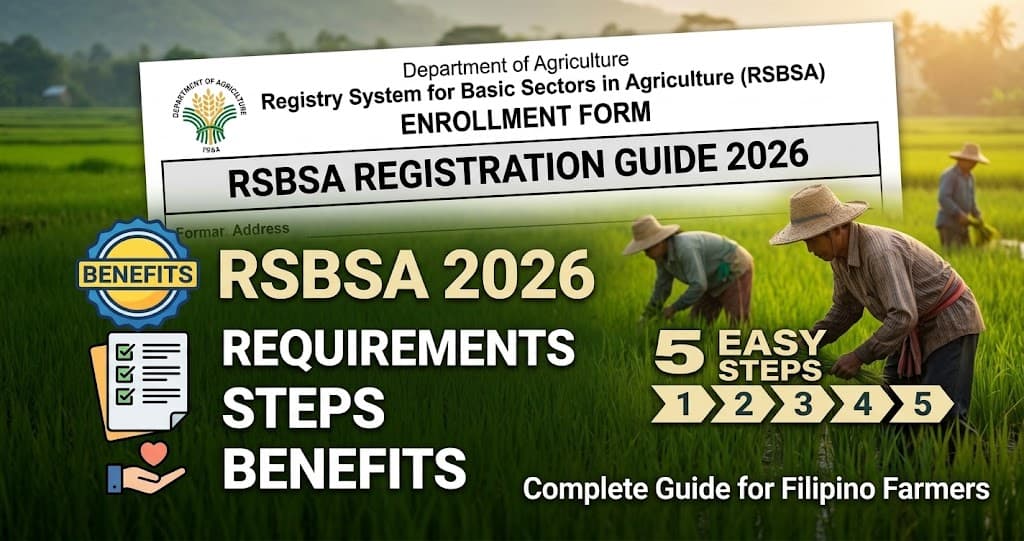
RSBSA Registration 2026: 5 Steps, Requirements, Benefits and Farm Loan Providers
What is RSBSA and Who Should Register?
The RSBSA stands for the Registry System for Basic Sectors in Agriculture. It is the official master list of real farmers, farmworkers, and fisherfolk in the Philippines managed by the Department of Agriculture (DA) and local government units.
Filipino citizens who are at least 18 years old and actively work in farming, fishing, or agricultural tasks can register for the Department of Agriculture's Registry System for Basic Sectors in Agriculture (RSBSA).
Here is who qualifies under each category:
Farmers: People who own, land-lease, or manage farmland to grow crops like rice, corn, vegetables, fruits, or coffee.
Farm Laborers or Workers: Individuals who work on farms owned by others, doing tasks like land preparation, planting, weeding, and harvesting as their main source of income.
Livestock and Poultry Raisers: Backyard or commercial raisers who grow animals like cows, carabaos, pigs, goats, ducks, or chickens.
Fisherfolk and Fish Workers: Small-scale municipal fishermen, fishpond owners, and workers in fish farming or aquaculture.
Agri-Youth: Young Filipinos aged 18 to 30 who are actively involved in agricultural work, farm management, or formal farming training.
Benefits of RSBSA: Why You Should Register
Signing up for the RSBSA is your direct access pass to official government support. Once your name is in the Department of Agriculture (DA) system, you can unlock three main types of assistance:
1. Subsidies & Aid
Free Seeds and Discounted Fertilizer: Get vouchers to claim free planting seeds (rice, corn, vegetables) and discounts on fertilizer.
Gas and Machine Help: Get fuel cards to get discounts on gasoline or diesel for your water pumps and tractors.
Cash Help: Qualify for direct cash assistance, like the Rice Farmers Financial Assistance (RFFA) for rice farmers with 2 hectares or less, when crop prices drop or hard times hit.
2. Insurance Support
Free Crop Insurance: Get free crop insurance from the government Philippine Crop Insurance Corporation (PCIC) for your rice, corn, and high-value crops.
Protection for Farm Animals: Cover your farm animals like pigs, cows, goats, and chickens against disease and sudden death.
Disaster Payouts: Get paid back if a typhoon, flood, drought, or pest outbreak destroys your farm.
3. Financial & Loan Support
Low or Zero-Interest Farm Loans: Borrow money to buy farm supplies through government programs like ACPC and LANDBANK.
No Collateral for Some Loans: Some programs, like ACPC's Agri-RECOVER calamity loan, need no collateral.
Emergency Calamity Loans: Access recovery loans after natural disasters so you can replant right away without turning to loan sharks.
RSBSA Requirements: What to Prepare
To register for the Registry System for Basic Sectors in Agriculture (RSBSA) in the Philippines, you must prepare an accomplished enrollment form, a valid government ID, ID pictures, and proof of your farming or fishing activity.
RSBSA Registration Form: Get it for free at your Municipal Agriculture Office, or download the RSBSA registration form.
Valid ID: Bring any official government ID, such as your National ID, UMID, Driver's License, Voter's ID, SSS, GSIS, or Passport.
ID Picture: Prepare 1 to 2 recent ID photos (1x1 or 2x2, depending on your office) with a clean white background.
Proof of Farming or Fishing Activity:
If you own the land: Bring a copy of your Land Title, Tax Declaration, Certificate of Land Transfer (CLT), Certificate of Land Ownership Award (CLOA), or Free Patent.
If you rent or work on the land: Bring a lease agreement, a written note from the landowner, or a Barangay Certificate proving you are the one farming the field.
Download the RSBSA form (PDF)How to Register in RSBSA: 5 Steps
Step 1: Visit the Office
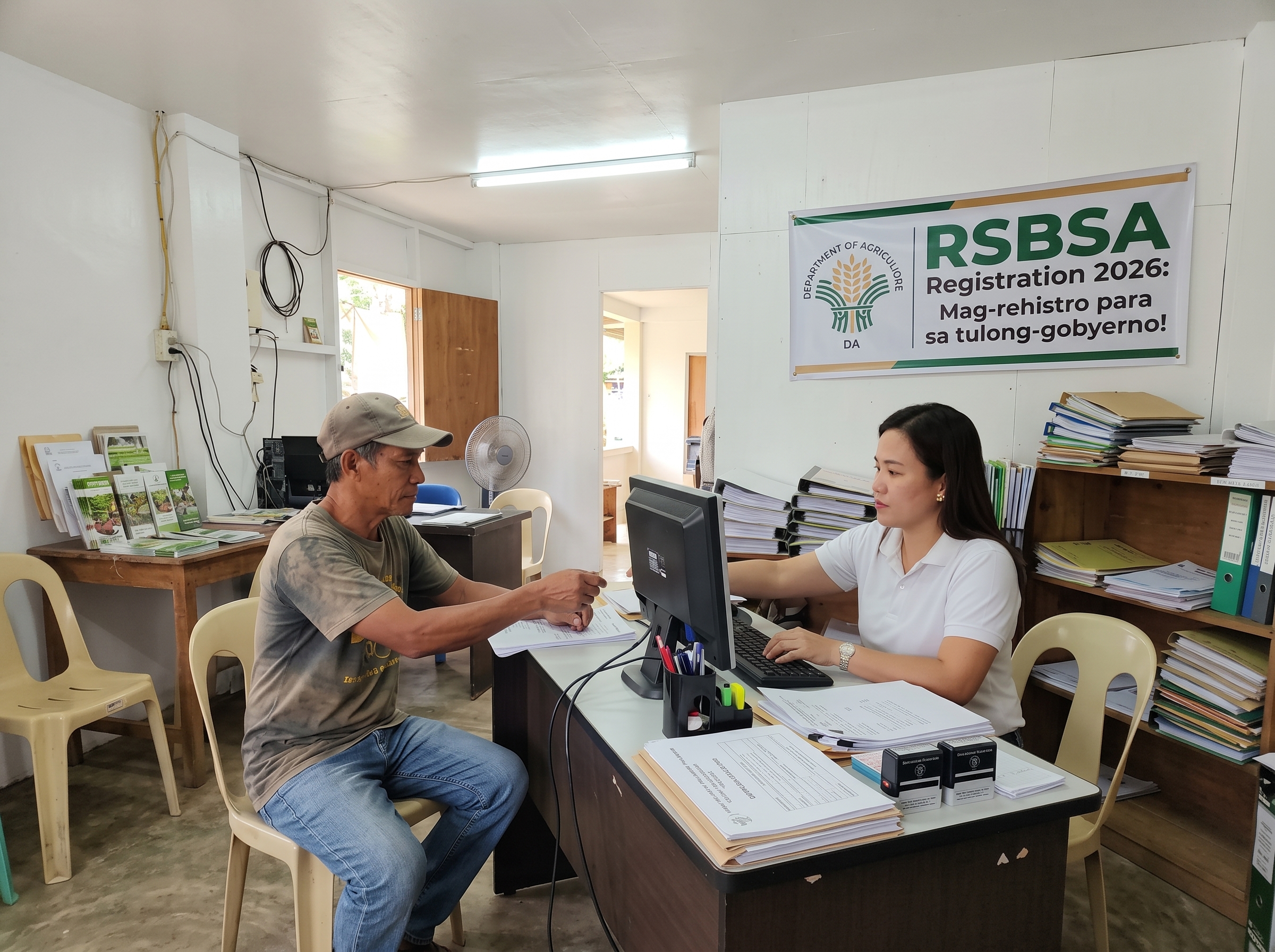
Go to your Municipal Agriculture Office (MAO) or City Agriculture Office (CAO) in your town hall and ask for an RSBSA form.
Step 2: Fill Out the Form
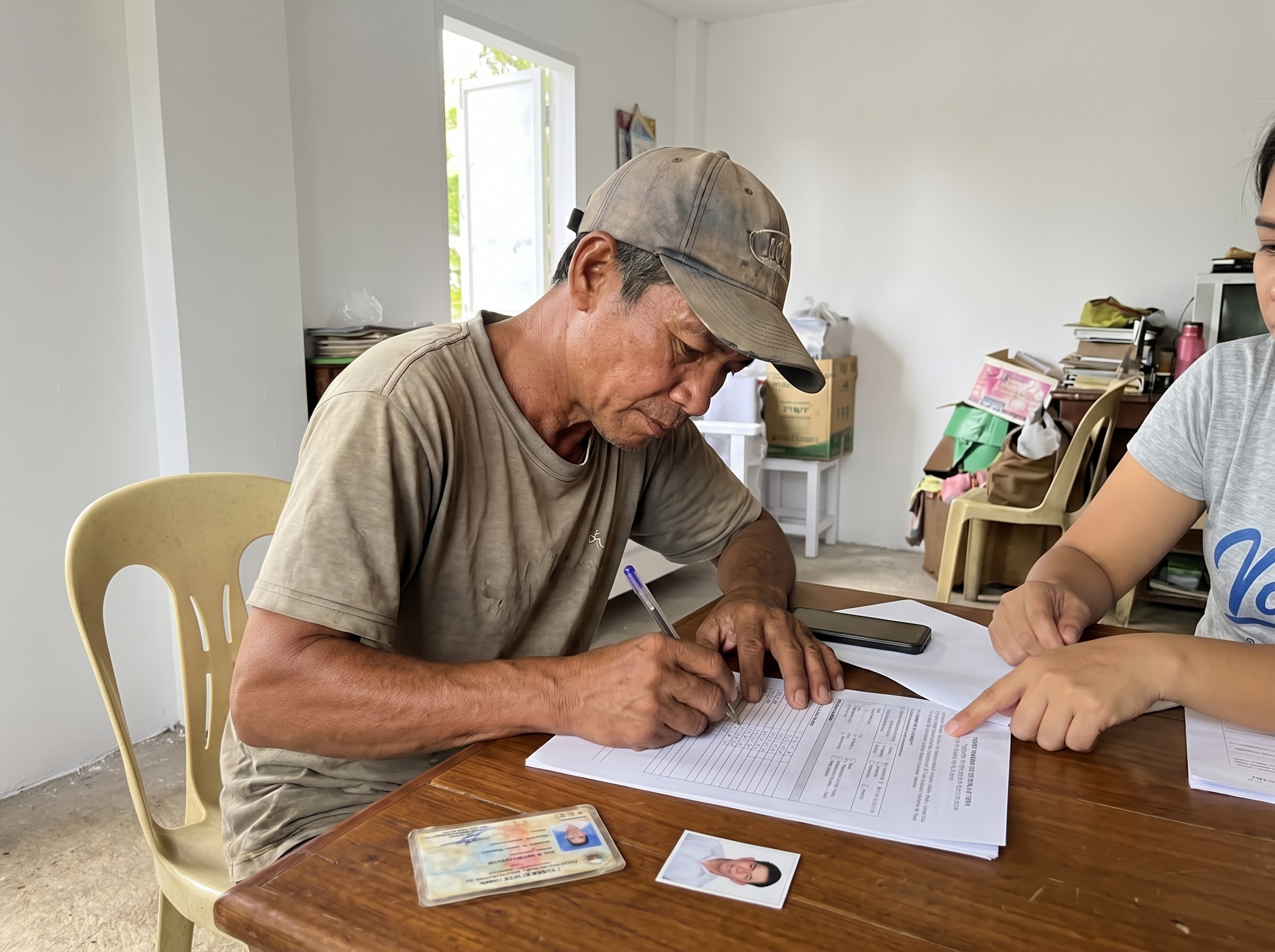
Write down your personal details, your address, the size of your farm, where it is located, and the crops or animals you raise.
Once you are done filling out the form, you must have it signed by the following authorized officials:
Barangay Chairman
City or Municipal Agriculture Office
City or Municipal Agricultural and Fishery Council (CAFC/MAFC) Chairman
Step 3: Submit Documents
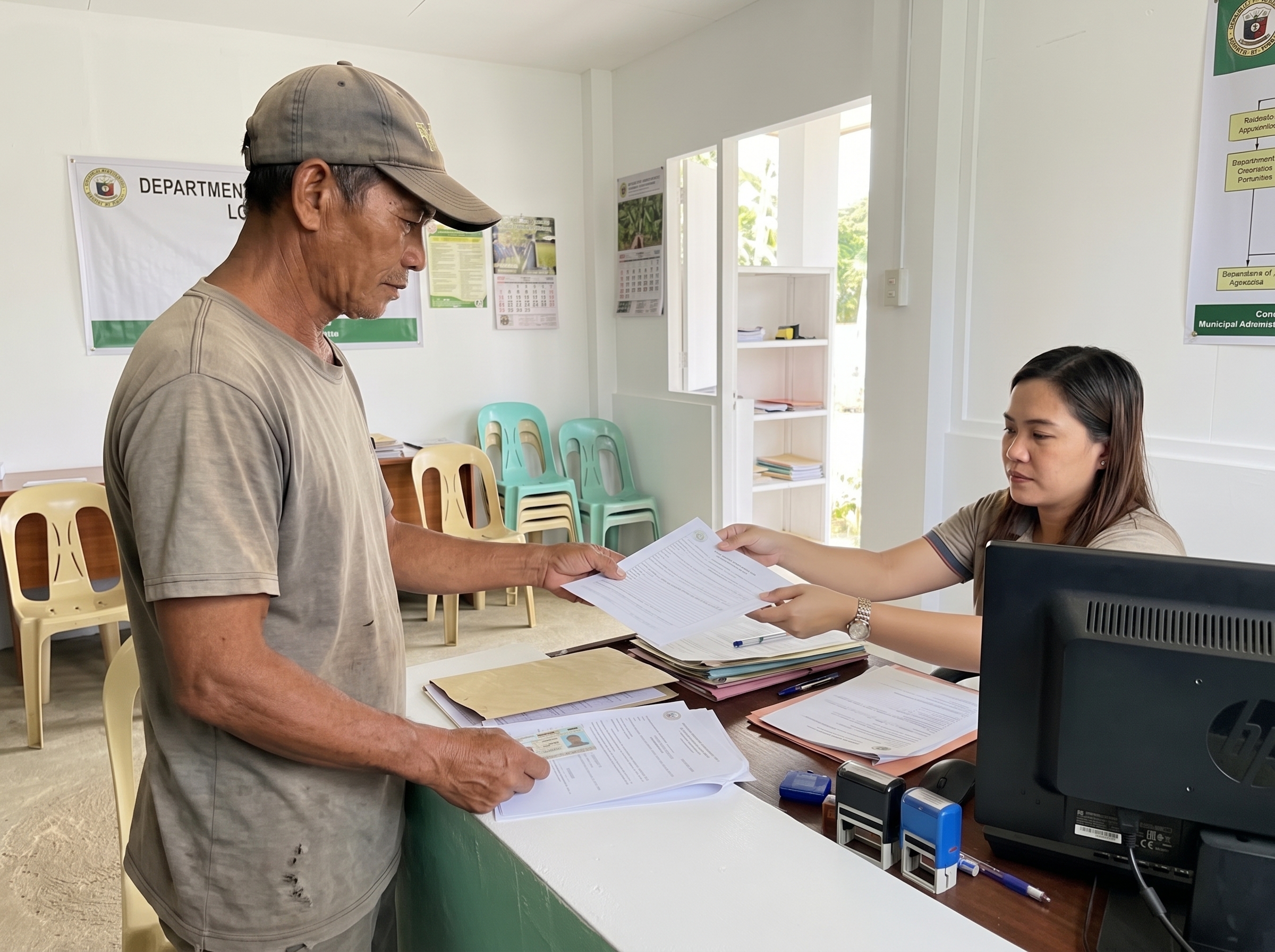
Submit your completed papers and ID to the agriculture office in your town hall. The staff will verify your documents, encode your profile into the DA system, and check that all your farm details are complete.
Step 4: Validation and Geotagging
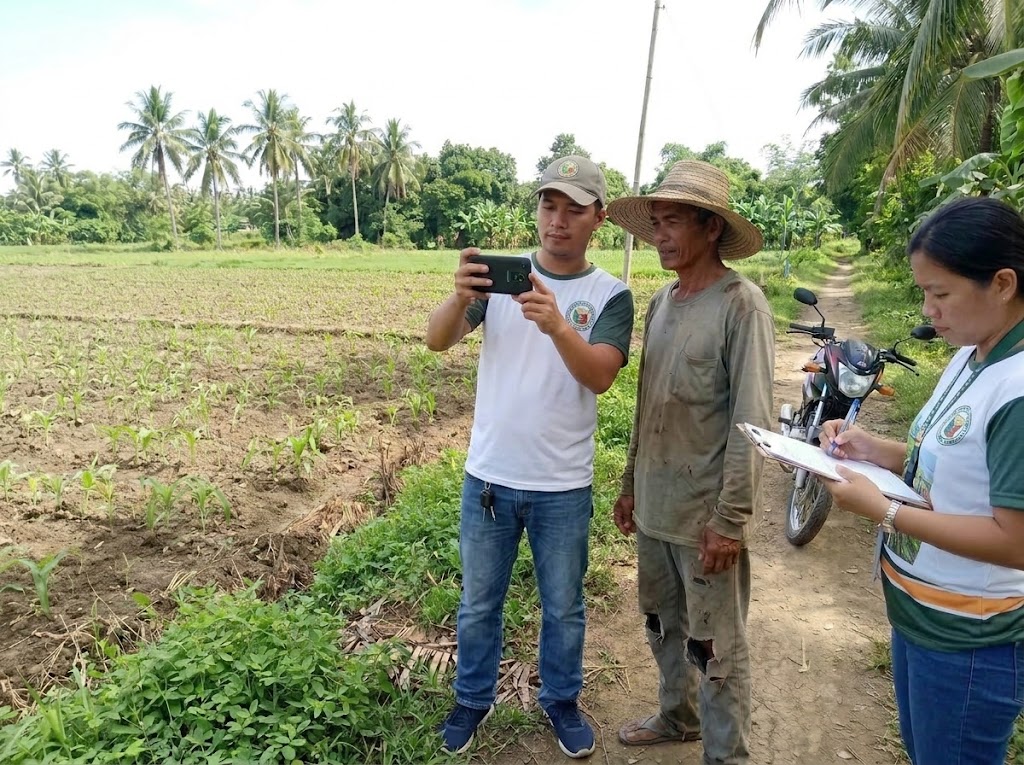
Municipal staff will review your papers and may schedule a visit to georeference (map and tag) your farm.
Step 5: Get Your Unique RSBSA Number
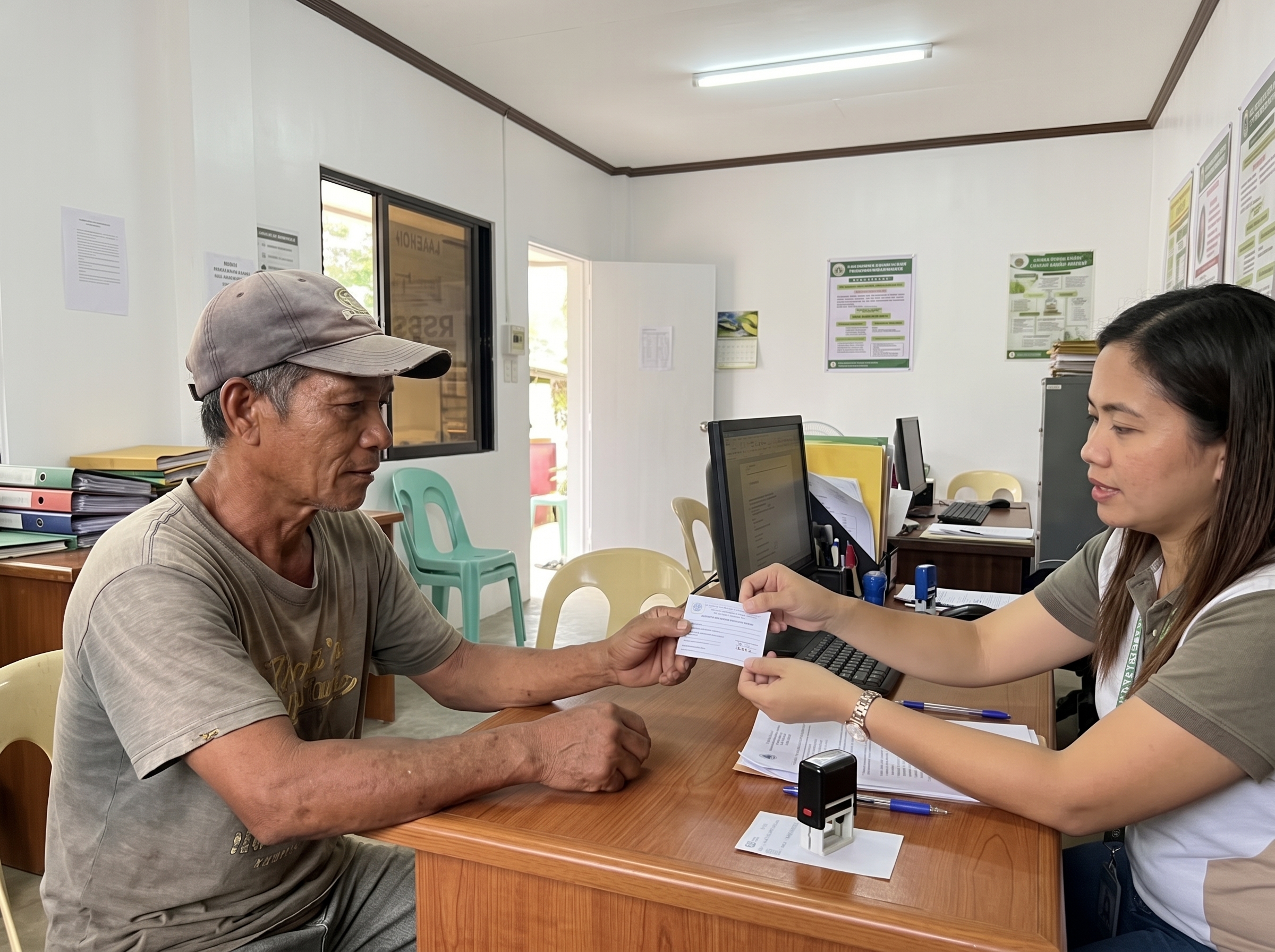
After your signed form is submitted, you get a stub with a reference number. Keep it as proof that you have enrolled. Once your profile is encoded, the system issues your unique RSBSA Registration Number. Keep a record of this number because you will need it whenever you apply for government subsidies, insurance, or loans.
RSBSA Verification: Check Your Registration and Number with RSBSA Finder
If you want to check your RSBSA number or see if your name is active, you can use the official RSBSA Finder registration website.
RSBSA Finder requirements: you only need your full name, sex, and birthday, written the same way as on your RSBSA form. The site also asks you to tick a reCAPTCHA before you click Search.
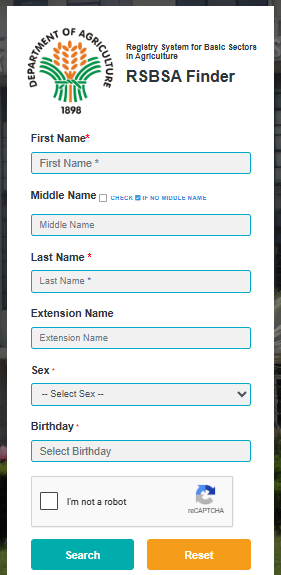
Steps to Check Your Name:
1. Open your phone or computer browser and go to: https://finder-rsbsa.da.gov.ph/
2. Type in your details:
First Name, Middle Name, and Last Name (check "If no middle name" if you don't have one)
Extension Name (type Jr., Sr., or III if you have one; leave it blank if none)
Sex (Male or Female)
Birthday
Tick the reCAPTCHA box and click Search.
If your application is encoded, your name and RSBSA Registration Number will show on the screen. This is how RSBSA-registered farmers can confirm their status online.
Open RSBSA FinderNote: If your name is not found yet, visit your local Municipal Agriculture Office to check if your form is still being processed.
PCIC Crop Insurance for RSBSA Farmers
Typhoons and pests can destroy your crops. The Philippine Crop Insurance Corporation (PCIC) helps pay for your losses so you don't lose all your capital.
PCIC Insurance Coverage: What Is Covered?
Crops: Rice (palay), corn, vegetables, fruit trees, and high-value crops.
Livestock: Cattle, carabao, swine (including ASF), goats, and poultry.
Farm Equipment: Tractors, water pumps, and harvesters against flood, fire, and storm damage.
Fisheries & Aquaculture: Fish cages, ponds, seaweed farms, and boats.
How to Apply for PCIC Crop Insurance
1. Coverage is NOT Automatic: Being registered in the RSBSA makes you eligible for free government insurance, but you must still submit an application for every planting season. Your farm is not insured until you apply.
2. Who Gets Free Insurance: Free insurance is for subsistence farmers and fisherfolk listed in the RSBSA. The government pays 100% of the premium. In 2026, rice and corn cover rose to up to ₱25,000 per hectare. Ask your MAO about the size limit in your area.
3. When to Apply: Submit your application before planting or sowing seeds, or right as you plant.
4. Requirements to Bring:
Proof of RSBSA Registration (your RSBSA number or stub).
Completed PCIC application for crop insurance form (ask for it at your MAO or the nearest PCIC office).
Farm Details (farm size, location sketch, planting date, and crop variety).
Valid identification and a simple farm plan or budget (when required).
5. Where to Submit: Bring your documents to your Municipal Agriculture Office (MAO) or the nearest PCIC extension office. Once processed, you will receive confirmation that your crops or animals are officially covered.
How to File a PCIC Insurance Claim
If your insured crops or animals are damaged, file a Notice of Loss as soon as possible. You can file at your Municipal Agriculture Office, at the PCIC office, through your barangay, or by calling, texting, or emailing your PCIC regional office. A PCIC adjuster will visit to check the damage before the claim is paid.
How they check your farm: An adjuster visits your field to check the damage. For big typhoons, PCIC may also use weather data and satellite mapping to help speed up claims.
How you get paid: Depending on your region, payouts can go to your GCash wallet, a LandBank prepaid card, or Palawan Express, so you can get the money faster and start replanting.
Government Farm Loan Programs
Looking for a loan for farmers in the Philippines? Start with these official lenders. Most of them will ask for your RSBSA number first.
Lender | Type | Loan size | Interest | Best for |
|---|---|---|---|---|
Government agency (DA) | Up to ₱500,000 (KAYA) | 0% (partner fee up to 3.5% for KAYA) | Start-up or recovery capital | |
Government bank | Up to ₱1 million (ACEF) | 2% to 4% a year | Machinery, rice production, expansion | |
Government bank, via partner banks | Depends on partner lender | Depends on partner lender | Farmers whose rural bank works with DBP | |
Rural bank (BSP) | Small loans | Check with the bank | Small livelihood and farm loans | |
Microfinance NGO (SEC) | Small loans | Check with KMBI | Small loans with enterprise training |
1. ACPC (Agricultural Credit Policy Council)
What is ACPC? The Agricultural Credit Policy Council is the DA agency behind the government's zero-interest loans for small farmers and fisherfolk. It doesn't release the money itself: approved loans go out through partner rural banks and cooperatives.
💰 Loan programs:
Agri-Negosyo (ANYO): up to ₱300,000, payable within 5 years
KAYA, for ages 18–30: up to ₱500,000
Agri-RECOVER calamity loan: up to ₱35,000, no collateral, payable over up to 3 years, for farmers hit by an officially declared calamity or emergency (launched September 2026)
📉 Interest: 0%. Partner lenders may add a small service fee, up to 3.5% for KAYA.
📋 ACPC loan requirements: valid ID, proof of RSBSA registration, loan application form, and a simple business plan.
👤 Who qualifies: RSBSA-registered small farmers, fisherfolk, agri-youth, and their cooperatives.
📝 How to apply: sign up through ACPC's online system (linked on each program page), attend the program briefing (and a business planning workshop if asked), then ACPC forwards your file to a partner bank or cooperative.
🎯 Best for: small farmers who need start-up or recovery capital without interest.
See ACPC loan programs2. LANDBANK (Land Bank of the Philippines)

The government bank for farmers and fishers. It lends directly and also runs DA-funded loan programs.
💰 Loan programs:
AgriSenso Plus: crop, fishery, machinery, and post-harvest loans for small farmers, fishers, and agrarian reform beneficiaries, at a fixed 4% a year
ACEF Lending Program: up to ₱1 million for individual farmers and fishers (₱5 million for cooperatives), at 2% a year, covering up to 90% of the project cost
RCEF Credit: working capital for rice farmers and rice cooperatives listed in the RSBSA
Also: programs for sugarcane and coconut farmers. Ask your Lending Center.
📉 Interest: 2% a year for ACEF and 4% a year for AgriSenso Plus.
👤 Who qualifies: RSBSA-registered small farmers, fishers, agrarian reform beneficiaries, and their cooperatives.
📝 How to apply: bring a valid ID, your RSBSA number, and a simple farm plan and budget to the nearest LANDBANK Lending Center or branch, or call (02) 8405-7000.
🎯 Best for: farmers who need bigger loans for machinery, rice production, or expanding the farm.
Apply at LANDBANK3. DBP (Development Bank of the Philippines)
A government bank that funds farm loans mostly through partner rural banks and cooperatives, so you usually apply at your local rural bank rather than at DBP itself.
💰 Loan programs: Agriculture, Fisheries and Rural Development (AFRD) credit for small farmers and fishers, used for working capital, equipment, and farm upgrades
📉 Interest: depends on the partner rural bank or cooperative.
👤 Who qualifies: small farmers, fishers, and their cooperatives, through DBP's partner lenders
📝 How to apply: ask your local rural bank or cooperative whether it offers DBP-funded farm loans
🎯 Best for: farmers whose local rural bank or cooperative works with DBP
Visit DBPPrivate Lenders: How to Avoid Scams
If you borrow from a private lender, choose a BSP-registered rural bank, a CDA-registered farmer cooperative, or a registered microfinance institution like the ones below.
4. CARD Bank
A microfinance-oriented rural bank supervised by the Bangko Sentral ng Pilipinas. It grew out of the Center for Agriculture and Rural Development, started in 1986.
🏦 Registered with: BSP (rural bank)
💰 Offers: small loans for livelihood and farming. Check current products on their site.
🔗 Website: cardbankph.com
🎯 Best for: small farmers and families who need a small loan from a regulated bank.
5. KMBI (Kabalikat para sa Maunlad na Buhay, Inc.)

A microfinance NGO registered with the SEC that offers small loans to low-income families, including an Agri Loan Program for farmers.
🏦 Registered with: SEC (microfinance NGO)
💰 Offers: group and individual loans, plus an Agri Loan Program. Check current terms on their site.
🎯 Best for: small farmers who want a small loan with enterprise training.
Visit KMBIHow to Check if a Lender is Safe and Legal
To protect yourself from fake online lending apps with extremely high interest rates, always check these official registers:
1. Rural Banks: Look for the bank on the Bangko Sentral ng Pilipinas (BSP) Directory.
2. Cooperatives: Make sure your local coop has a certificate from the Cooperative Development Authority (CDA).
3. Loan Companies: Make sure corporate lenders are registered with the Securities and Exchange Commission (SEC). Never borrow money from unregistered loan apps on your phone.
Frequently Asked Questions (FAQ)
Is RSBSA registration free?
Yes! RSBSA registration is completely free. Government offices do not collect any payment for forms or processing.
Can I register if I do not own the farmland?
Yes. Tenant farmers and farmworkers can register. You only need a written agreement from the landowner or a Barangay Certificate confirming that you farm the land.
Does my RSBSA registration expire?
No, but you should update your information at your local agriculture office whenever your farm size, crop type, or contact details change.
Can I register for RSBSA online?
Not fully. You still enroll in person at your City or Municipal Agriculture Office. The online tool, RSBSA Finder, only lets you check whether you're already registered and see your RSBSA number.
What is an RSBSA number?
It's the unique registration number the DA gives you once your RSBSA form is encoded. You'll need it when applying for subsidies, PCIC insurance, and farm loans.
Sell Your Harvest Directly on FarmyHub
Getting registered in the RSBSA opens the door to subsidies, insurance, and farm loans. Once your farm is up and running and ready for harvest, the next step is getting a fair price for your crops. Check current market prices in our monthly Price Report.
FarmyHub connects Filipino farmers with buyers, restaurants, and market vendors across the country. There are two ways to start:
List your products yourself, for free. Create a free account in seconds with your Google or Facebook account, then post your harvest in a few minutes. Once approved, your listing is visible to buyers, who can message or call you directly.
🌱 List your products for freeBecome a FarmyHub supplier. Tell us about your farm, your products and how much you can supply. Our team will contact you to learn about your business, and when a bulk buyer is looking for what you grow, we can recommend you.
🤝 Become a supplierPrefer using your phone? Download the free FarmyHub app to post listings and reply to buyers on the go.
📱 Get the app on Google PlayRegistered agriculturist, higher education instructor, and hands-on farmer. I write practical farming and agribusiness guides based on my work in the field and in the classroom.